MeetSecuritain—Built by Cloudain for Modern Cloud Securitysecuritain.com
Securitain extends security visibility, control intelligence, and continuous assurance across data centers, private cloud, public cloud, identities, applications, data, APIs, and banking platforms.
One security intelligence layer across hybrid banking infrastructure.
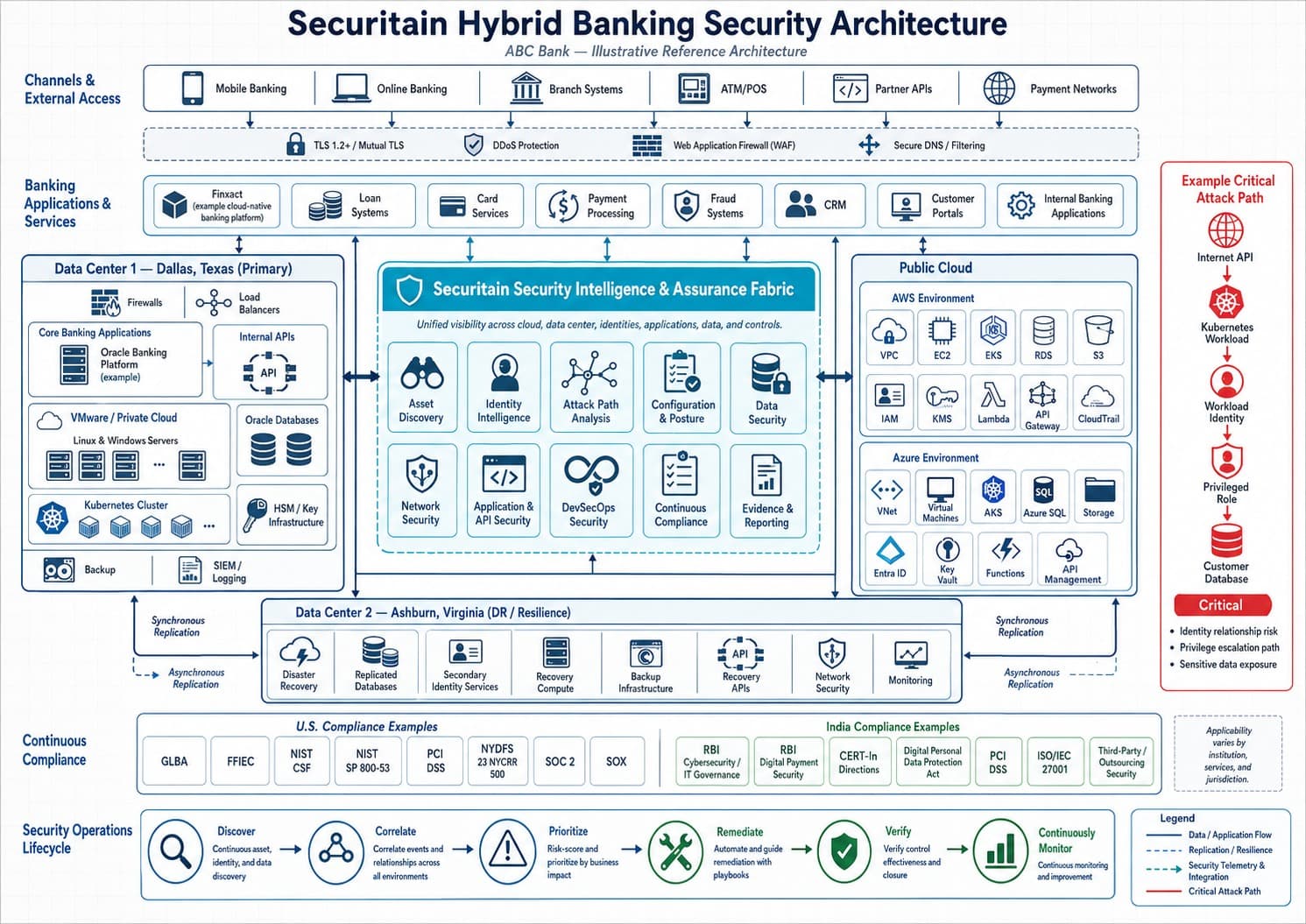
Illustrative hybrid architecture visualization — click to view full screen
TLDR — Executive Summary
For CISO · CTO · SVP · Head of Security — understand this page in 60 seconds
The Problem
Banks run across data centers, private cloud, AWS, and Azure — but no single tool shows what's exposed, who has dangerous access, and whether controls are actually working across every environment at once.
What Securitain Does
Connects security context — identities, data, infrastructure, compliance — across your entire hybrid estate into one view. Your team prioritizes and acts instead of correlating fragmented reports from siloed tools.
Right Now (Illustrative)
8 attack paths can reach customer financial data. Identity risk is elevated. 91% of controls are passing — but 12 have drifted and need review before your next audit.
How It Works
Read-only connectors pull metadata from your existing tools — no rip-and-replace. Securitain tells your team what's risky, why it matters, and what to fix first, mapped to your specific compliance obligations.
ABC Bank is a fictional institution used throughout this page to illustrate how Securitain fits into a complex, regulated hybrid banking environment. ABC Bank operates a distributed estate spanning two data centers, private cloud, and multiple public cloud providers — a pattern common across mid-size and large banking institutions.
Primary data center
Dallas, Texas
Resilience data center
Ashburn, Virginia
Public cloud footprint
AWS + Azure
Core banking model
Hybrid on-prem + cloud-native
Filter by security domain to see how identity, data, cloud, infrastructure, network, application, and DevSecOps relationships thread through every layer of ABC Bank's estate.
Oracle Banking Platform
Example enterprise core banking platform
Finxact
Example cloud-native core banking platform
Additional banking applications
Dallas Data Center
Ashburn Data Center
Public Cloud (AWS + Azure)

Securitain Security Intelligence & Assurance Fabric
Spans every layer above — context, identities, relationships, risk & evidence
Select a domain above to highlight the matching identities, data, and infrastructure relationships across the canvas. Scroll horizontally to pan; use the zoom controls to adjust scale.
Filter by security domain above and revisit this section — the same domain tags carry through so you can trace identity, data, or network relationships from the primary site to the resilience site.
Primary banking infrastructure
Secondary / resilience environment
Connectivity between environments (conceptual)
Represented conceptually — Securitain does not require or mandate any particular connectivity product.
ABC Bank runs workloads on both major public cloud providers. Securitain's architecture is intentionally multi-cloud — it is not built around one provider.
Illustrative service footprint
Illustrative service footprint
Example enterprise core banking platform
Example cloud-native core banking platform
Oracle Banking Platform and Finxact are shown only as illustrative examples of common core-banking platform categories. This page does not suggest that Oracle or Finxact endorse, formally integrate with, or have any business relationship with Securitain.
Securitain does not replace every firewall, SIEM, IAM platform, or banking application. It connects security context, configuration, identities, relationships, risks, controls, and compliance evidence across the estate.
Securitain is a correlation, posture, and evidence layer — not a replacement for SIEM, EDR, firewalls, IAM, PAM, core banking systems, or your SOC. Those systems remain the source of enforcement; Securitain makes their context visible together.
Correlates users, roles, service accounts, workload identities, and federated trust across every environment.
What Securitain evaluates
Follows sensitive data across databases, storage, and replication paths, wherever it lives in the estate.
What Securitain evaluates
Builds a living inventory of cloud resources, servers, databases, applications, APIs, and identity objects.
What Securitain evaluates
Watches configuration and control drift across data centers, Kubernetes clusters, and cloud infrastructure.
What Securitain evaluates
Maps relationships across data-center networks, cloud VPC/VNet boundaries, and hybrid connectivity paths.
What Securitain evaluates
Maps applications to APIs, identities, databases, and cloud resources to surface dangerous chains.
What Securitain evaluates
Extends context into git repositories, CI/CD pipelines, artifact registries, IaC, and Kubernetes workloads.
What Securitain evaluates
Illustrative dashboard mockup.
17
Critical Risks
Findings needing immediate action
12,842
Hybrid Assets
Servers, DBs, identities & APIs monitored
143
Privileged Identities
Accounts with elevated or admin access
8
Attack Paths
Routes an attacker could use to reach customer data
91%
Controls Passing
Security controls verified across all environments
12
Control Drift
Controls that have drifted — near-term compliance risk
Top security risks
| Risk | Environment | Severity | Compliance Impact |
|---|---|---|---|
| Excessive privileged service identity | AWS — EKS workload | Critical | NIST 800-53 AC-6, PCI DSS 7 |
| Unencrypted database replication | Dallas ↔ Ashburn | Critical | GLBA Safeguards, NIST CSF PR.DS |
| Internet-exposed API path | Azure — API Management | High | FFIEC guidance, PCI DSS 1 |
| Dormant privileged account | Dallas — Enterprise IAM | High | NIST 800-53 AC-2, RBI IT Governance |
| Cross-environment trust risk | AWS ↔ Azure federation | Medium | NYDFS 500.07, ISO/IEC 27001 A.9 |
Executive Takeaway
Your overall security posture is 78/100. There are 17 critical risks and 8 attack paths that can reach customer financial data — these are the findings your team should focus on this week. 91% of controls are passing, which means the baseline is strong. The 12 drifted controls represent your near-term compliance exposure going into your next audit.
78 / 100
Hybrid Security Posture
Elevated
Identity Risk
Strong
Data Protection
8
Critical Attack Paths
91%
Compliance Readiness
12 controls
Control Drift
Drill-down path
A single hybrid security posture score across every environment ABC Bank operates.
Critical Attack Path
An externally reachable application can assume a workload identity with access to a privileged role that can reach customer financial data.
Critical
Severity
6
Assets involved
3
Identity relationships
7
Compliance controls affected
The path traverses six assets across two identity boundaries: an internet-facing digital banking API, a Kubernetes-hosted service, its workload identity, a privileged cloud role, the core banking integration layer, and the customer database it can ultimately reach.
Finding
Overprivileged workload identity
Context
Digital banking API running in cloud Kubernetes
Risk
Identity can assume a role capable of reaching customer-data storage.
Compliance Impact
Multiple access-control and data-protection controls affected.
Recommended Action
Restrict role assumption and replace broad permissions with workload-specific least privilege.
Verification
Securitain rescans the relationship and verifies the attack path has been removed.
Executive Takeaway
An attacker can move from a customer-facing web app to core banking data in just 6 steps — all through normal-looking system relationships that no single security tool would flag on its own. Securitain finds these chains before attackers do, maps every asset involved, and tells your team exactly what to fix and in what order. Each attack path also lists the compliance controls it violates, so your remediation effort directly reduces audit exposure.
Every category below is either a capability available today or part of Securitain's extensible connector architecture. This page does not claim integrations that have not actually been implemented.
Bank workloads and sensitive financial data remain within the bank-controlled environment at all times.
Securitain collects only the security metadata, configuration, relationships, evidence, and telemetry required for authorized analysis.
Deployment and data-handling models can be adapted to institutional security and regulatory requirements.
Securitain-hosted control plane analyzes the security metadata collected via read-only, least-privilege connectors.
Metadata and evidence travel over private network paths instead of the public internet.
Processing components run inside bank-controlled infrastructure for institutions with strict data-residency requirements.
Private Connectivity and Bank-Controlled / Private Deployment are shown as architecture options and are not yet production offerings.
Security cannot focus only on production. Securitain evaluates security consistency across the primary and resilience sites, and across cloud providers.
Executive Takeaway
Most security tools only watch production. During a DR failover to Ashburn, your backup environment can have weaker access controls, stale permissions, and gaps in encryption — all invisible until an audit or an incident. Securitain monitors your primary site and your DR site with the same rigor, so a failover doesn't become a security event.
Every technical control should be traceable to the regulatory, security, and audit obligations it supports.
Executive Takeaway
Instead of a manual point-in-time audit, Securitain continuously maps every technical control to the specific regulation it satisfies — GLBA, FFIEC, NYDFS, RBI, PCI DSS, NIST, and others. When your auditors or regulators ask for evidence, your team has it ready and traceable, not scrambled together from spreadsheets and screenshots.
Applicability depends on institution type, jurisdiction, services, data processed, and regulatory obligations. Not every framework listed applies to every bank.
Discover assets, understand identity and data relationships, identify dangerous attack paths, map technical controls to compliance obligations, and continuously verify security across cloud and data-center environments.
Designed for complex, regulated hybrid environments.

